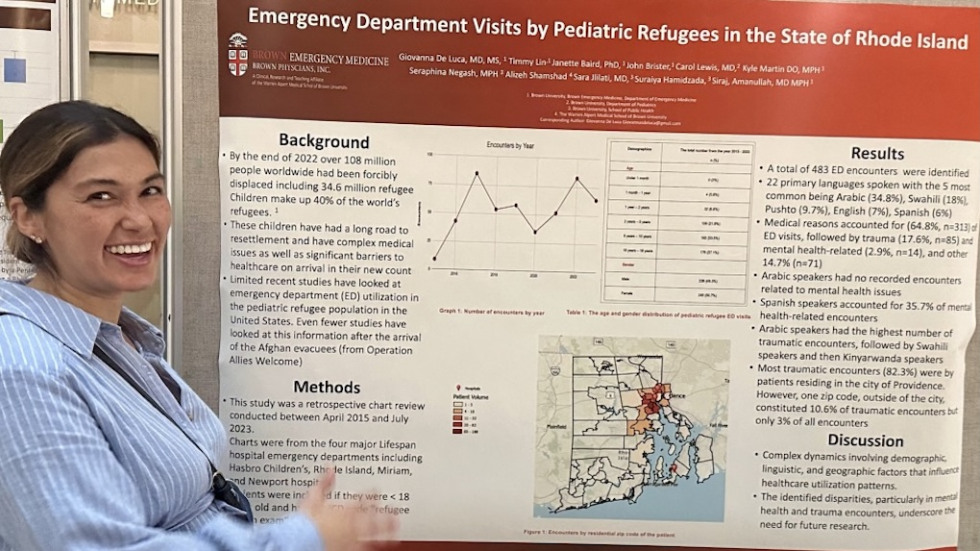
Dr. Deluca received the 2026 Humanitarian Service Award from the Global Emergency Medicine Academy (GEMA), an academy of the Society for Academic Emergency Medicine (SAEM). She was honored during the SAEM26 annual meeting held in Atlanta, Georgia, from May 18–21, 2026. Dr. Deluca is one of the co-directors of the new Collaborative on Forced Migration and Health program within the Center for Global Health Equity at Brown.
In this conversation, Dr. Deluca reflected on her experiences working with refugees and forced migrants and offered advice to members of the Brown community interested in similar work.
What sparked your interest in working with refugees and forced migrants?
Much of my career has been spent working internationally. Over time, I realized that there was also a vibrant international community right at my doorstep in the United States—an incredibly resilient people who often arrive after experiencing profound trauma and now face significant barriers to healthcare. I became passionate about supporting this population and helping improve access to equitable care in their new communities.
What research are you currently working on in this area, and how will it be impactful?
My current research spans both local and international settings. In Rhode Island, I work in partnership with the Refugee Dream Center to strengthen healthcare access among local refugee and immigrant communities. Internationally, I collaborate with partners along the Thai–Myanmar border to develop and evaluate emergency care systems in resource-limited settings serving displaced populations. I run the Pre-clinical elective for refugee health at the medical school and work as co-faculty advisor for Brown Human Rights Asylum Clinic.
What advice do you give to Brown students who are interested in working with these populations, either in the U.S. or abroad?
Be thoughtful and intentional about the organizations and communities you choose to work with. Approach this work with humility, recognizing that refugees are not defined by their displacement—they are intelligent and joyful individuals navigating extraordinary challenges. Remember that working with these communities is a privilege: they will teach you as much as you hope to contribute, and those lessons will shape you both professionally and personally.
The Collaborative on Forced Migration and Health program will provide community members opportunities to become involved in this work. Medical students at the Warren Alpert School are also encouraged to get involved with the Brown Human Rights Asylum Clinic.