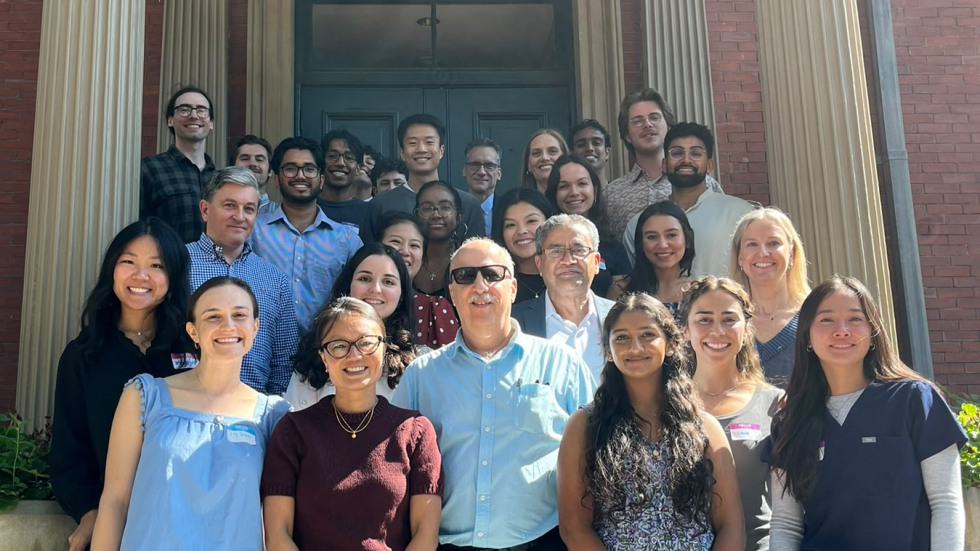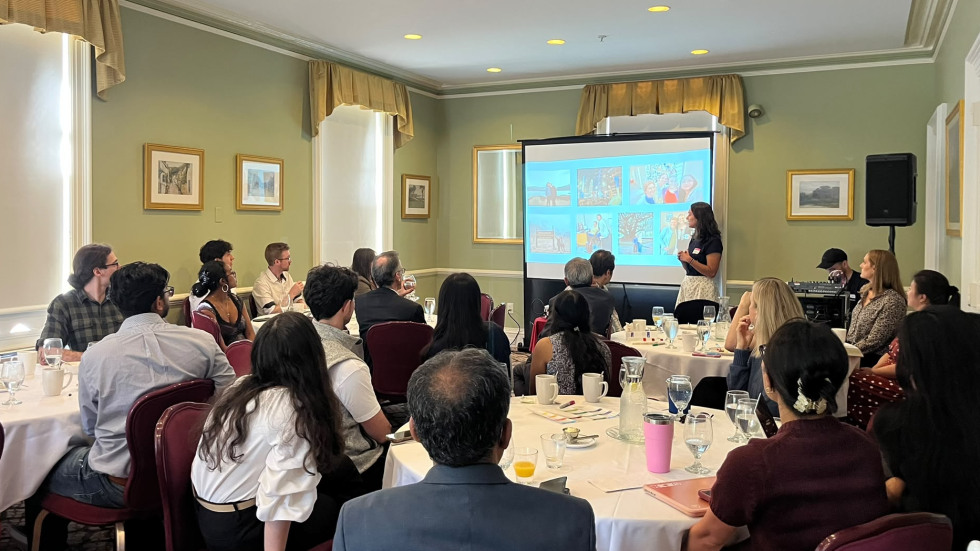
At the Community Breakfast, 26 scholars (the program's largest cohort yet) shared their experiences, reflected on their research, and connected with fellow scholars and faculty members.
The Emerging Infectious Disease and HIV Scholars Program (HEIDS)
Brown University’s HEIDS program seeks to develop a physician-scientist workforce engaged in clinical research with the aim of informing practical responses to HIV and associated infections. Through didactic training, lectures, in-person training, and networking opportunities, the program provides a foundation for clinical research and equips a community of scholars with the resources needed to become leaders in research and treatment of emerging infectious diseases. The program is supported through a grant by the National Institutes of Health (2R25AI140490).
Rohan Cherukuru, MD ‘29: Cytomegalovirus Reactivation and latrogenic Opportunistic Infection Burden in Glioblastoma
Working with Dr. Eric Wong on immune deficiency and infection risk in glioblastoma, Rohan and his team investigated the extent of immunocompromise in glioblastoma (GBM) patients following treatment and evaluated risk-monitoring practices. GBM is an aggressive, fast-growing cancerous tumor, originating in the brain, the treatment of which includes dexamethasone, radiation, and temozolomide, all associated with decreases in lymphocyte count. After reviewing 485 GBM patients treated at Brown Health from 2014-2022, the team found a high immune burden: 2/3 of patients evaluated were lymphopenic, and 94% of these patients had never received Cytomegalovirus (CMV, a common herpes-family virus which, in immunocompromised populations, may cause organ damage) testing. The team found a similar trend nationally, with under 2% of patients overall, and nearly 98% of severely lymphopenic patients never receiving CMV testing.
Hamsa Shanmugam, MD ‘29: Community-Based HIV & Anti-Parasitic Programs
This summer, Hamsa worked with the International Centre for Child and Public Health & Shanti Ashram in Coimbatore, India to evaluate the capacity of Sudar, a 30-year longitudinal community-based HIV support program in rural parts of Coimbatore district. The Sudar program primarily serves underprivileged women and children aims to build strong support systems, improve treatment adherence, and ultimately foster resilient communities. She also worked with her host institutions on their school-based anti-parasitic and malnutrition programs and engaged in clinical work at Ganga Hospital. Hamsa's global health research interests center rural surgery and health, and as a continuation of her global health research through HEIDS, she is currently designing a project on prevention and management of peri-operative infections in rural India under the guidance of her mentor, Dr. Ruhul Abid.
Meghan Moore, MD ‘29: Evaluating the Accuracy of a Noninvasive mHealth Screening Application for the Diagnosis of Moderate and Severe Anemia in the United States and Western Kenya
Despite the substantial burden of anemia in low- and middle- income countries (LMICs) in sub-Saharan Africa and South Asia, screening is not routinely performed due to lack of resources, distance from testing facilities, and cost. This project aims to evaluate the accuracy of an inexpensive, rapid, and noninvasive mHealth application, which estimates hemoglobin levels using a photo of a patient’s fingernails. Initial optimization of the Ruby Health application was primarily completed using blood samples of patients with either normal hemoglobin or mild anemia. More extensive patient data, especially for hemoglobin values less than 10 g/dL, are needed to further refine the application’s accuracy and to maximize its potential for successful implementation as a rapid screening tool for anemia in LMICs. Within the Brown University Health system, a total of 56 patients with known anemia were identified, and fingernail scans were completed in triplicate. Compared to gold standard complete blood count hemoglobin values, the Ruby Health application overestimated hemoglobin, with mean absolute errors above 3 g/dL for fingernail scans taken both with and without a color matching card. While use of the color card did not improve overall accuracy of scans, the card did significantly improve repeatability, as demonstrated by lower within-patient variability across the color card triplicate scans. Future directions include the collection of more data to further optimize Ruby Health’s algorithm for recognition of lower hemoglobin values — both within the Brown University Health system and in collaboration with international partners in western Kenya to evaluate the feasibility of incorporating this screening tool in a real-world LMIC setting.
As HEIDS Scholars, these students are provided dedicated research training and opportunities like abstract submissions, conference presentations, and publications related to the grants aims are fully sponsored by the program.
Join us in congratulating this impressive cohort of physician scientists in training!
To learn more about HEIDS, check out their webpage: https://globalhealth.brown.edu/research/heids